We help media and creative companies stop watching the AI moment and start building in it.
Immersion
Clear eyes on where AI actually touches your business.
Education
Fluency built around your real work, until it's culture.
Adaptation
Rebuild the assumptions your budgets are built on.
Forward Deployment
What if stops being a meeting and becomes a build.
Names you know, work you mostly can’t see yet. The partners you can.
See the partner wall
At the forefront, not the intersection.
Twenty years inside premium non-fiction — HBO, Hulu, A+E, Vice.
Then startups and companies still building their own enterprise — Viceland from a blank page, premium content at Anonymous Content, a stretch inside Web3.
The throughline isn’t non-fiction. It’s the edge of an emerging market, asking what if before the rules exist. Right now, that market is AI.
AI didn’t change the question. It changed what happens after you ask it.
It’s not a tool story. In 1999 they told David Bowie the internet was “just a tool.”
Everyone claims a seat at the intersection of storytelling and AI. An intersection is where you watch the traffic. The forefront is where you build it.
The floor came up. Experiments that were too expensive to imagine are cheap enough to try. We help you see what’s now standing on it — and get building.
Viewport. What if, actually.
Four phases. One map.
Most companies start at ground level. The nimblest already have altitude. Every engagement is scoped to where you actually are.
Immersion
Webinars, seminars, one-on-ones — we take inventory of what you’re actually working with: the tools already in use, the organization’s real temperature, where leadership’s appetite ends and the misgivings begin. You leave with a plain-language brief: what’s already happening, what the copyright exposure actually is, and where your lines get drawn — pre-viz only, iteration tool only, or open. That brief is what everything after it gets scoped against.
Education
Starts as a single workshop, scales into a series built around specific goals and learning targets — not a generic curriculum. We use real work as the classroom: an actual RFP, a workflow that’s actually stuck, a challenge that’s actually ripe for AI. This is team altitude — people solving real day-to-day problems together, not sitting through a demo. The goal is tool builders, not tool users: fluent enough to start vibe coding their own solutions.
Adaptation
This is where your existing team — the people you already hired well — gets new capability, not new pressure. More output, less tedious work, more of the high-level thinking you hired them for in the first place. We rebuild the workflow around what that team can now do: more iteration, more ideas tried, more of the work that used to get cut for time. You leave with a team operating at a plateau they couldn’t reach a year ago.
This is also where the network comes in. We bring in the right people for what your team can’t or shouldn’t build alone — vendors and studios who become production or development partners, individual artists and technologists who take on a specific problem, consultants who know exactly the ground you’re standing on. It’s the part of the job most consultants skip. By the time you’re ready for Forward Deployment, the right people are already at the table.
Forward Deployment
The phase the first three earn. New revenue, products, and experiences built on your brand and IP — interactive formats, avatars, 3D worlds, learning products. You leave with a working prototype, not a pitch deck. The New York Times move: a legacy brand growing into a bigger business than its old medium ever allowed.
The killer app of a new medium is never a cheaper version of the old one. It’s the neumorphic thing that couldn’t have existed before.Doug Shapiro · The Mediator
Education before adoption. Fluency before strategy. Agency before invention.
Book a discovery call
Who we build with.
From decades-old networks to streamers, studios, and brands stepping into new formats — the client changes, the arc doesn’t: get clear on where AI actually touches the business, build the fluency, rework the assumptions the budgets rest on, then ship what used to be a “what if.”
Some of what we build stays under NDA. The partners don’t.



One legacy network. All four phases — discovery calls to prototypes in production.
Client named under NDA · details anonymized
A decades-deep factual-television network — real audience, real IP, a large distributed org, and no shared read yet on what AI meant for the business. Classic fog.
The full arc: open-ended discovery, workshops that scaled from small groups to a company-wide cohort, a production-process audit, then a working set of prototypes — AI pre-viz, historical-figure avatars, 3D reconstruction, and an edtech product built on the network’s own IP.
Fluency from the C-suite to the edit bay. Prototypes shipped, not pitched. Two projects that began as “what if” conversations are now in production.
What Fred talks about.
Not AI hype, not tool demos. The pattern underneath: what happens to a creative business when the floor moves — and why the companies that came through the last five hype cycles are the ones that built instead of watched.
- 01Twenty years of hype cycles, one survival pattern.
Unscripted TV, premium television, digital publishing, Web3, now AI — the shape rhymes every time. History beats prediction.
- 02The forefront, not the intersection.
An intersection is an address. The forefront is where you find out what’s possible by building it.
- 03What if, actually.
Unscripted development ran on two words for decades. AI changed what happens after you ask it.
- 04Synthetic media and truth.
Provenance, authenticity, and what nonfiction owes an audience when the tools can fabricate anything — from Stanford’s Starling Lab.
- 05Legacy brand, new products.
How a company with real IP builds forward the way the New York Times did — not cheaper, bigger.






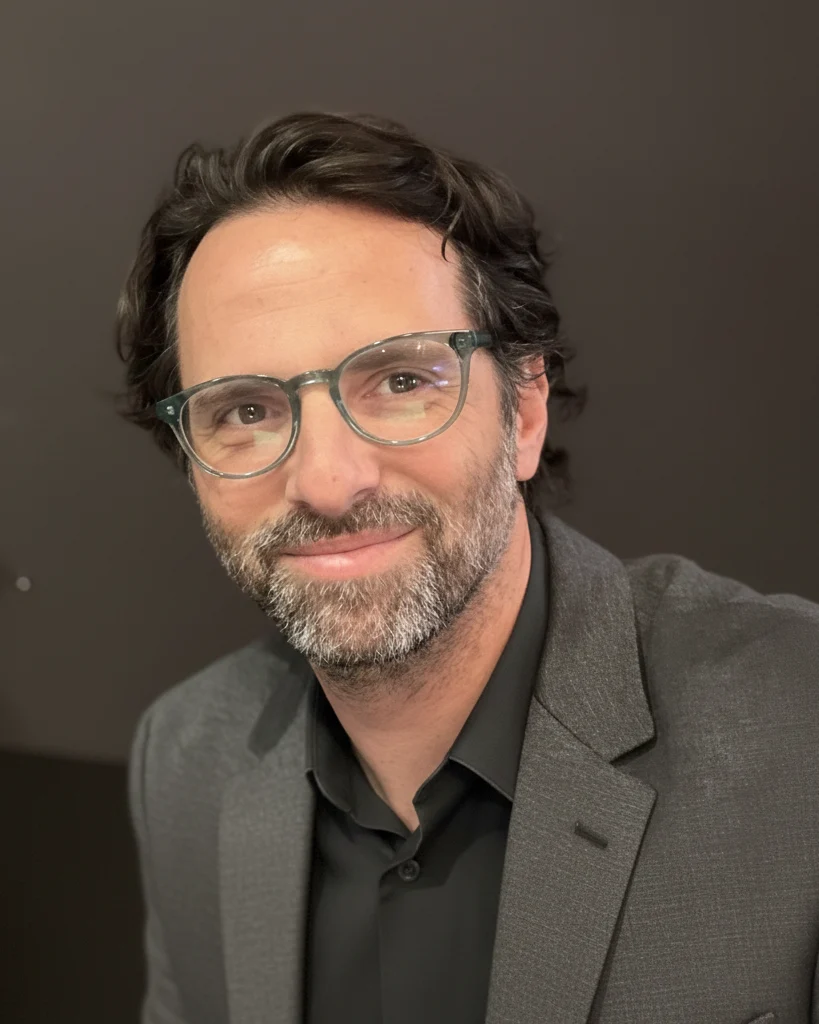
About Fred.
For twenty years I’ve worked through media’s hype cycles, usually from more than one seat. I bought television as a network executive and sold it as a producer (HBO, Hulu, A+E). I helped launch Viceland alongside a team led by Spike Jonze, ran premium content at Anonymous Content, and went deep on Web3’s questions about ownership and a more participatory creator economy.
Every one of those rooms ran on the same two words: what if. What if a game show happened in the back of a taxi (Cash Cab). What if the audience became the reporter. What if the people who make the work owned a real stake in it. AI only changed what happens after you ask.
So when this cycle arrived, I built inside it — co-founding Machine Cinema with Minh Do, a handful of us in LA backyards that became a global association of 15,000+ AI creatives and builders. Same move every cycle: working at the front, not watching from the intersection.
Today I run Viewport Labs — helping creative companies stop watching this moment and start building in it, from legacy businesses with a high-stakes transformation to studios lost in the fog of tools and workflows. Behind the practice:
- —Program Head of the generative AI filmmaking master's at LABASAD, after teaching Cinematic AI at USC (MFA) and Chapman.
- —Research on nonfiction integrity in synthetic media as a Fellow at Stanford’s Starling Lab.
- —Created the “AI for Documentaries” course for Curious Refuge’s online AI filmmaking academy.
- —Hands-on with Machine Cinema's growth and curriculum.
It isn’t about efficiency, and it isn’t about the fear of being left behind. It’s a once-in-a-generation reset in how creative industries govern themselves and thrive. We find the ways to reach the forefront and build forward.


The community behind the practice.
Fred co-founded Machine Cinema with Minh Do — a handful of people in LA backyards that grew into a global association of 15,000+ AI creatives, builders, and technologists.
It exists because, for the first time, anyone with a story to tell can bring it to life — in film, in games, in experiences we haven’t even named yet. The tools that used to require studios and budgets are open to everyone. Generative AI is the creative Renaissance of our time, and a new generation of storytellers, artists, and builders is inventing a new language, one experiment at a time.
Machine Cinema is the community, the events, and the shared knowledge this creative moment needs. It’s home to the GenJams, the meetups, and the practitioner network where Viewport finds many of the builders on its engagements.
Fred hosts GenTalks, the Machine Cinema podcast — a running conversation with the people actually making things with generative AI: how they work, what broke, what they’d build next.

Elsewhere on the mic: Fred hosted eight episodes of the Curious Refuge podcast.